
TNFD Releases Major Update to Guidance Supporting Corporate Nature-Related Reporting

The Taskforce on Nature-related Financial Disclosures (TNFD) announced the release of LEAP 2.0, the first upgrade of its core approach and guidance for helping companies assess and report on nature-related dependencies, impacts, risks and opportunities.
The TNFD was launched in 2021, building on the success of the Task Force on Climate-related Financial Disclosures (TCFD), to support organizations in reporting and acting on their nature-related risks. The organization published its final recommendations for nature-related risk management and disclosure in September 2023, alongside its LEAP approach to identifying and assessing nature-related issues. To date, more than 1,000 organizations across 56 countries have published disclosures aligned with the TNFD recommendations.

The release of the new LEAP approach marks one of the last major technical work projects for the TNFD, with the organization announcing last year that it would end its technical work program in late 2026, following plans by the IFRS Foundation’s International Sustainability Standards Board (ISSB) to begin work on standard setting for disclosure requirements on nature-related risks and opportunities. The ISSB has said that its nature-based disclosure work will draw on the LEAP approach. The TNFD has also indicated that it will contribute to the development of an ISO standard based on the LEAP 2.0 assessment approach.
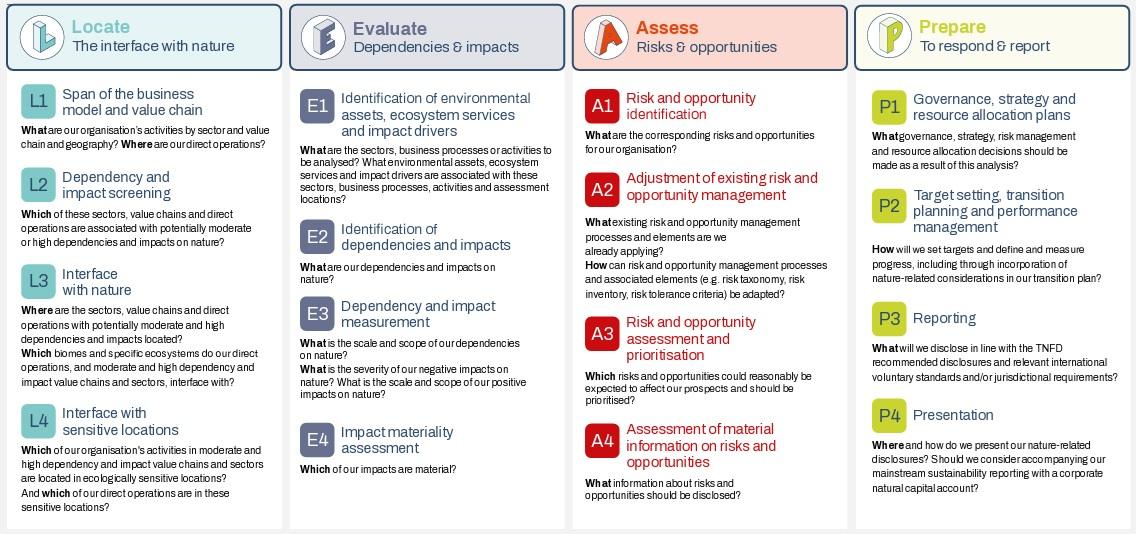
The TNFD’s LEAP approach guides organizations through four phases – Locate, Evaluate, Assess and Prepare – to understand its interface with nature, evaluate nature dependencies and impacts, assess the ensuing nature-related risks and opportunities, and prepare nature-related disclosures.
The TNFD said that its new LEAP 2.0 integrates a number of updates and improvements based on market feedback. Key changes include increased guidance for the assessments of nature-related risks and opportunities, the state of nature measurement to support the evaluation of dependencies and impacts, guidance for assessments of financial institutions’ portfolios, considerations of environmental crime, nature in transition planning, in addition to new guidance on invasive alien species measurement. The approach also integrates State of Nature Indicators and Metrics, a new set of indicators and metrics for measuring the state of nature, released by the Nature Positive Initiative.
The LEAP 2.0 approach was released ahead of the upcoming COP 17 UN biodiversity conference, and alongside updated science-based nature target setting methods launched by the Science Based Targets Network (SBTN), in addition to the new NPI metrics.
TNFD CEO Tony Goldner said:
“The market has moved quickly in recent years, with thousands of organisations now working to understand and respond to their nature-related issues. As implementation accelerates, it is essential that assessment, target-setting and reporting approaches work together in a practical and mutually reinforcing way.”
Click here to access TNFD’s LEAP 2.0.
Image source: TNFD