
Growth in Demand for Workers with Green Skills Outpaces Supply in 2025: LinkedIn Survey

Workers that have acquired green skills are seeing substantial career benefits, including seeing hiring rates far above their peers, as corporate demand for green workers continues to outpace the pace of new green skills development in the workforce, and as workers with green skills are increasingly hired for roles beyond those with specific sustainability titles, according to a new study released by professional talent social network LinkedIn.
For the study, LinkedIn’s Green Skills Report 2025, LinkedIn analyzed anonymized and aggregated profile information of it’s one billion members around the world, utilizing data from 84 countries from January 2021 through July 2025, and determining skills from those explicitly listed on member profiles or inferred from other aspects of members’ profiles, and the identification of 1,200 green skills using expert taxonomists.
One of the report’s key findings is that both green hiring and green skills development continued to grow in 2025, but not at an equal pace, leaving a potential green skills gap. According to LinkedIn’s data, from 2021 – 2025, the annual pace of green skills growth was 3.4%, well below the share of green hires of 6.2%.
This trend was even further exacerbated over the past year, with growth in green hiring from 2024 to 2025 rising by 7.7%, nearly double the 4.3% rate of growth of green skills in the global workforce.
In the report, LinkedIn said:
“If we do not drastically accelerate green skills development, we will leave both climate action and economic opportunity on the table. For governments, educators, and employers, the recognition of green transitions as an economic opportunity is a moment ripe for much greater investment in people.”
The report also found that green skills are becoming embedded more broadly across enterprises, and moving beyond niche sustainability-focused functions. According to LinkedIn, for example, the study found for the first time that non-green titles accounted for the majority of green-skilled worker hires, at 53% in 2025.
The report said:
“These are jobs that could traditionally be done without green skills, but where green skills are increasingly applied to support the climate and energy transition, underpin adaptability, and drive business value. Put together, green skills are increasingly foundational rather than niche and have emerged as a competitive edge in today’s labor market.”
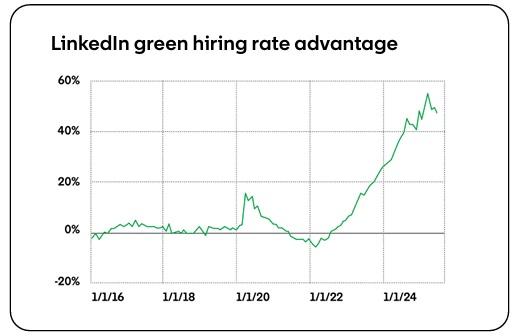
As demand for green skills outpaces development, and as green-skilled workers are tapped for a wider range of roles, workers with green skills are also seeing significant employment advantages, according to the report, which found that the hiring rate for workers in the green talent pool is 46.6% higher than that of the global workforce overall. Notably, the hiring rate impact has spiked over the past few years (see chart below).
The green skills advantage comes as workers themselves increasing want to be employed in green jobs, with a LinkedIn September 2025 survey finding that 43% of workers would ideally like a job that contributes to energy transition or climate adaptation, with even stronger interest among younger workers, including 5 in 10 millennials and 6 in 10 Gen-Z respondents.
The report also found that the growth in green hiring trends has been ubiquitous across regions, with all 47 countries for which LinkedIn has data showing an increased share of green hires from 2021 to 2025. By major economies, the U.S. saw one of the strongest annual growth rates of 8.9%, behind Brazil at 10.7%, but ahead of the UK (7.8%), Germany (5.4%) and France (4.9%).
By industry, the Technology, Information and Media sector experienced the most growth in its share of green hires from 2021-2025 at an 11.3% rate, with strong growth as well in Transportation, Logistics, Supply Chain, and Storage (8.0%), as well as Financial Services (7.5%). Notably, all sectors in 2025 saw the share of green hires outpacing their current green talent concentration, indicating growth in the proportion of workers with green skills in each sector over the past year.
Sue Duke, Vice President of Public Policy & Economic Graph at LinkedIn, said:
“As green skills spread throughout the economy, they are helping deliver what businesses and governments care most about – adaptability, resilience, efficiency, competitiveness and innovation. The path from climate ambition to action is paved with economic opportunity for workers, businesses and governments, but the gulf between demand and supply of skilled workers continues to put this at risk. We will only close the gap if decisive action is taken now to make skills and workforce training a core part of climate and energy policy.”
Click here to access the report.